
Opis
SUMMARY
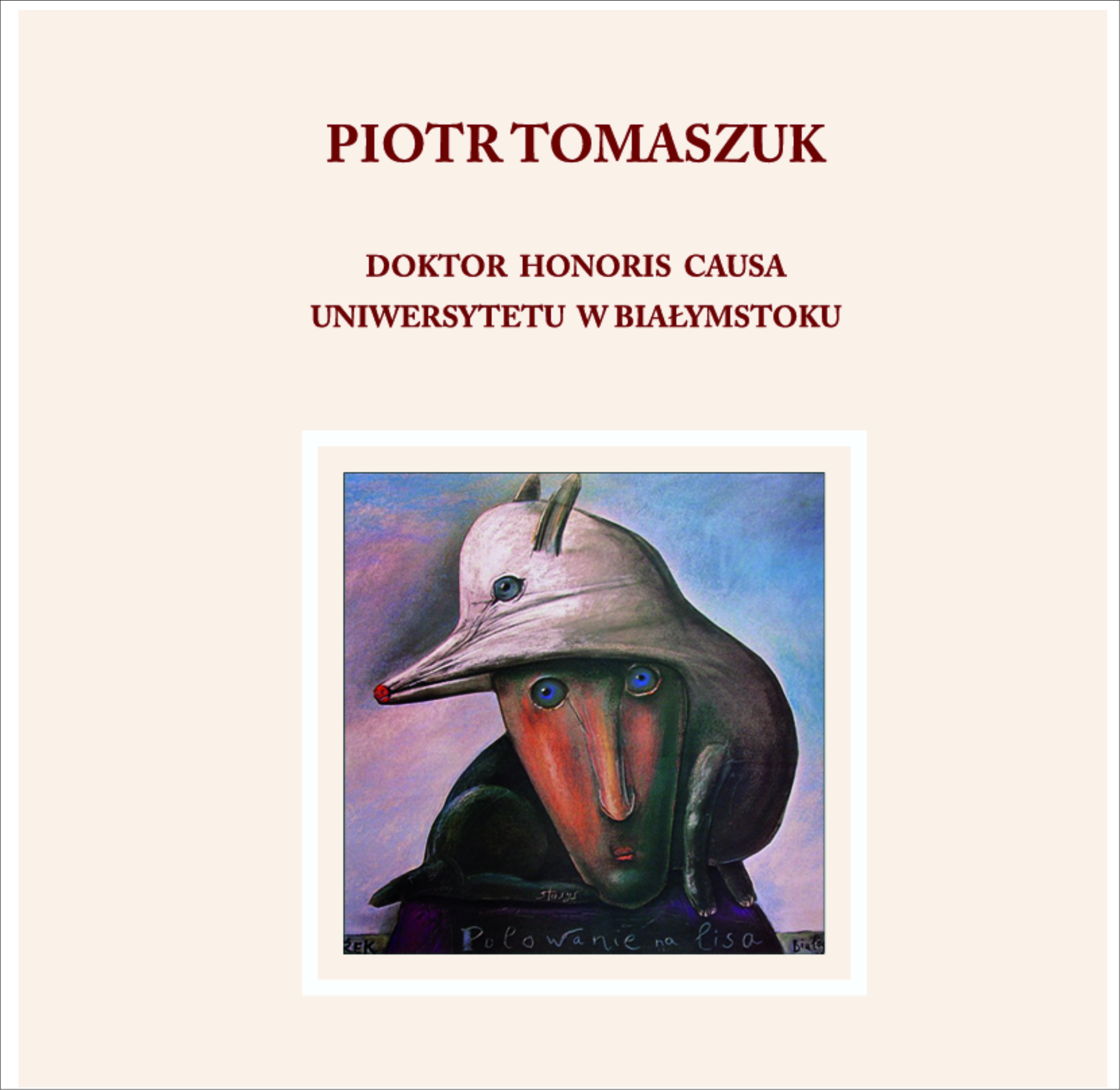
This publication is associated with the celebration of awarding the honorary doctoral degree of the University of Białystok to Mr. Piotr Tomaszuk, an outstanding Polish director, playwright, co-founder, and manager of the avantgarde Wierszalin Theatre in Supraśl. The celebration took place on the 28th of October 2026 at the Auditorium of the Faculty of Philology of the University of Białystok, at the new Humanities Building at ul. Ciołkowskiego 1 S. This was the third (after the well-known theoreticians of Romanticism: Professor Halina Krukowska and Prof. Alina Kowalczykowa) doctorate awarded by the University upon a motion by the Faculty of Philology. The procedure of awarding the honorary degree started with “Resolution No. 17/2025 of the Council of the Faculty of Philology of the University of Białystok of July 2, 2025, on filing a motion to award the honorary degree of Doctor Honoris Causa to Mr. Piotr Tomaszuk”. The appointed supervisor of the procedure was Prof. Jarosław Ławski, Head of the Department of Philological Studies “East – West” and the Dean of the Faculty of Philology. Three prominent reviewers were designated to assess the achievements of the candidate: Professor Piotr Biłos of the National Institute of Oriental Languages and Civilisations (Inalco), a theoretician of Polish and European literature of the 20th and 21st centuries; Prof. Wiesław Czołpiński, Professor of Art Studies, director, and Rector of the Aleksander Zelwerowicz Theatre Academy in Warsaw; and Prof. Dariusz Kosiński of the Jagiellonian University, one of the most prominent Polish theatrologists, who conducts studies on the performative tradition.
All the reviewers referred to the biography and the extensive list of creative achievements of Mr. Tomaszuk who was born on the 17th of June 1961 in Białystok. He is a theatre and television director, a playwright and a screenwriter, the co-founder of the Wierszalin-Theatre Association and of the Wierszalin Theatre. Since 2006 also the Manager of the Wierszalin Theatre. He was three times awarded the Fringe First Award at the Edinburgh Festival for the plays: Turlajgroszek (1993), Merlin (1994), and Medyk (1997). He graduated from the graduated from the Puppet Theatre Directing at the State Drama School in in Białystok. He started his theatre career in 1984 as the Assistant Director at the Puppet Theatre in Białystok. In 1986, he debuted with the play About the Physician Feliks based on a story by Gustaw Morcinek. The breakthrough performance that brought him nationwide recognition was Turlajgroszek, which he directed at the Puppet and Actors’ Theatre “Miniatura” in Gdansk in 1990. It was shown in theatres of Poland, Japan, the USA, and Australia. In his work on the play, Tomaszuk was assisted by the playwright and theatre critic Tadeusz Słobodzianek. This was the beginning of the group of actors with whom Tomaszuk and Słobodzianek established the Wierszalin-Theatre Group in Supraśl.
Both the founders gave the theatre its artistic profile. Wierszalin was supposed to be a puppet and actors’ theatre that would seek its audience among adults rather than among children. The place of its emergence, i.e. the Białystok countryside, far from the cultural centres and on the border of Polish and Belarussian, Catholic and Orthodox influences, also determined the repertoire. The theatre drew from local legends and folk tales, and then from the cultural treasury of whole Europe. Merlin Inna historia by Tadeusz Słobodzianek (1993) referred to the Arthurian legends. Głup, based on the text by Tomaszuk (1996) was inspired by the tales of old people who lived near Supraśl, while Ofiara Wilgefortis (Wilgefortis’ Sacrifice) (2000) was based on medieval Spanish biographies of saints. In Wierszalin, Tomaszuk directed Klątwa (The Curse) by Stanisław Wyspiański (1994), which took the form of a folk rhapsode. He presented the abyss of mental illness in the moving performance Bóg Niżyński (God Nijinsky) based on the Diaries of the dancer. The play Wierszalin. Reportaż o końcu świata [Wierszalin. An Account of the End of the World] (2007) referred to the roots from which the Supraśl theatre emerged. Its hero was the prophet Ilya Klimovytch who established a heterodox cult in Podlasie in the 1930s and started the construction of the New Jerusalem, also known as Wierszalin. Furthermore, Marat-Sade by Peter Weiss (2008) was a theatrical form of expressing despair at the time of a cultural and historical transition. The achievements of Wierszalin Theatre under the supervision of Piotr Tomaszuk are of a universal and global nature, while they are also embedded in the cultural space of Podlasie. The Wierszalin Theatre performed multiple times in Japan, the USA, India, Mexico, and most European Countries, including at the World Expo in Hannover in 2000.
As Professor Piotr Biłos highlighted in his review: “Everything is gradually more and more intertwined in this artistic creation: the word, the body, the music, the image, the ritual, the community, memory of a place, Romanticism, Christianity, borderlands, madness, sacrifice, and resurrection. They are all but various versions of the same question: how to give a form to what transcends the ordinary order of the world in man? How not to betray the intensity of soul and, at the same time, not to let it dissolve in formlessness? How to bring the word through the body, the body through rhythm, the rhythm through community, the community through a test, and the test though memory? Therefore, one may say that the work of Piotr Tomaszuk is one of these scarce phenomena that restore theatre to the absolute seriousness. As a result, the achievements of Piotr Tomaszuk deserve the highest academic and artistic recognition, not only as a collection of outstanding realisations, but as a whole that has enriched Polish and European Theatre by its own language that is consistent, deeply thought-over and unique in the spiritual aspect”.
Professor Wiesław Czołpiński emphasised the importance of Romanticism for the model of the theatre created by Tomaszuk: “Dialogue with Polish Romanticism, in particular with the works of Adam Mickiewicz, has a special place in the creative works of Tomaszuk. The director makes consistent attempts at reinterpreting the romantic Imaginarium, highlighting its communal, spiritual and anthropological dimensions. His productions that were inspired by, inter alia, Dziady, Ballads and Romances, the lyrics of Lausanne or the Books of the Polish Nation and Polish Pilgrimage, are not of a reconstructive nature, but provide the author’s transposition, where the text by Mickiewicz is creatively transformed into a live stage ritual. Tomaszuk reads Romanticism as a space for dialogue between the visible and invisible worlds, between history and myth, which is consistent with the aesthetics of the Wierszalin Theatre that is rooted in the consciousness of the borderlands. Tomaszuk shows Dziady [The Forefathers’ Eve] as a ritualistic drama by reconstructing its ritualistic dimension and returning to their function of a communal experience. In his theatrical practice, Mickiewicz’s text becomes an impulse for creating a show as a performative act where the borders between the stage and the audience become blurred, and the theatre receives a status of a space of mediation between the worlds of those alive and the dead, history and the present, the sacred and the profane”.
Furthermore, prof. Dariusz Kosiński highlighted the affective aspect of the creator’s work: “Tomaszuk has, since the beginning, and still does give Wierszalin his own, artistic and human mark. I might even dare say that this is, at the moment, the only Polish theatre created by an author, which is still alive and creative, i.e. such that its concept and activities are an expression of the interests, needs, tendencies, and passions of one prominent, creative being. This formula, which once used to be fundamental for the main Polish independent groups (to mention only Cricot 2 and the Theatre of 13 Rows) is currently being considered anachronic. Many often point to the potential threats that it implies. Not to deny these, it is still impossible not to notice that the great strength of theatre created by authors was and still is the consistency in their search, bold strive to fulfil a genuine passion, readiness to fight for what is considered to be the most important in art, as well as to fulfil one’s own artistic desires, strive to answer tormenting questions, or, to refer to Grotowski once more, to follow one’s main temptation. This leads to the emergence of numerous conflicts, it may even become a source of dramas, yet at the same time it increases the temperature of artistic work so that it becomes not merely a profession performed more or less successfully, but a crucial element of life. In the context of Polish contemporary theatre, which is losing its vigour amidst what is otherwise a noble concern for the well-being of all, Wierszalin of Piotr Tomaszuk seems to me to be one of the last places still ablaze with such creative fervour”.
Based on the received reviews, the Senate adopted, on July 8 2026, “Resolution No. 3689 of the Senate of the University of Białystok of July 8 2026 on awarding the title of Doctor Honoris Causa of the University of Białystok to Mr. Piotr Tomaszuk”. The doctoral diploma contains the formula proposed by Professor Ławski: “To the prominent theatre director, co-founder of the Wierszalin Theatre, playwright and screenwriter, in recognition of his contribution in the development of Polish and global theatre, for the creative stage interpretations of contemporary Polish and world literature, including the works of Adam Mickiewicz, set in the cultural and historical reality of Europe, former Republic of Poland, and contemporary Podlasie”. The celebration on the 28th of October 2026 was attended by HM the Rector of The University of Białystok, Prof. Mariusz Popławski, prorectors, deans, and senators of the University, as well as a large number of guests from the artistic circles: actors, academics, and students. The celebration was complemented by the evening performance of the play God Nijinsky at the Wierszalin Theatre in Supraśl.
The present volume contains the text of the Resolutions of the Senate and the Council of the Faculty, the text of the submitted reviews, laudation by Prof. Ławski and the doctoral lecture by Piotr Tomaszuk. It also contains a photographic annexe presenting the artist and his theatre. The volume was edited by: Professor Jarosław Ławski (University of Białystok), supervisor of the procedure, as well as theatre lovers from Supraśl: Robert Szymula, PhD (University of Białystok), a Russian language scholar and linguist and Elwira Tomczyk, PhD, Polish language scholar and literary theoretician.
SPIS TREŚCI
Wstęp ………. 9
Uchwała nr 3689 Senatu Uniwersytetu w Białymstoku z dnia 8 lipca 2026 r. w sprawie nadania tytułu doktora honoris causa Uniwersytetu w Białymstoku Panu Piotrowi Tomaszukowi ……. 11
Piotr Tomaszuk – curriculum vitae ………. 13
Piotr Tomaszuk – osobistość polskiego oraz europejskiego teatru i dramatu.
Laudacja wygłoszona 28 października 2026 r. przez Promotora, prof. dr. hab. Jarosława Ławskiego …. 23
Człowiek i figura
Wykład doktorski Pana Piotra Tomaszuka wygłoszony 28 października 2026 r. podczas uroczystości w Auli Wydziału Filologicznego ……… 37
Prof. dr hab. Piotr Biłos
(Inalco, Paryż)
Piotr Tomaszuk: teatr słowa, rany i zmartwychwstania. Opinia w sprawie nadania Panu Piotrowi Tomaszukowi tytułu doktora honoris causa Uniwersytetu w Białymstoku …….. 47
Prof. dr hab. Wiesław Czołpiński
(Akademia Teatralna im. Aleksandra Zelwerowicza w Warszawie)
Recenzja w postępowaniu o nadanie Panu Piotrowi Tomaszukowi tytułu doktora honoris causa Uniwersytetu w Białymstoku ……… 65
Prof. dr hab. Dariusz Kosiński
(Uniwersytet Jagielloński)
Recenzja dorobku Pana Piotra Tomaszuka w postępowaniu dotyczącym nadania Mu tytułu doktora honoris causa Uniwersytetu w Białymstoku ……….. 71
Dokumentacja …………. 79
Uchwała nr 17/2025 Rady Wydziału Filologicznego Uniwersytetu w Białymstoku z dnia 2 lipca 2025 r. w sprawie wystąpienia z wnioskiem o wszczęcie postępowania w sprawie nadania tytułu honorowego doktora honoris causa Panu Piotrowi Tomaszukowi ……. 79
Uchwała nr 1/2026 Rady Wydziału Filologicznego Uniwersytetu w Białymstoku z dnia 16 grudnia 2025 r. w sprawie wskazania kandydatów na promotora oraz recenzentów w postępowaniu w sprawie nadania tytułu honorowego doktora honoris causa Panu Piotrowi Tomaszukowi …………….. 80
Uchwała nr 2/2026 Rady Wydziału Filologicznego Uniwersytetu w Białymstoku z dnia 16 grudnia 2025 r. w sprawie ustalenia projektu treści dyplomu doktora honoris causa zawierającego opis głównych zasług Pana Piotra Tomaszuka ………….. 81
Piotr Tomaszuk i jego teatr – aneks fotograficzny. Fotografowała Magdalena Rybij …….. 83
Résumé …………. 131
Summary ……….. 137
Zusammenfassung ………. 143
Indeks nazwisk ……….. 151


